

Daily Habits That Make Autoimmune Disease Worse (and What to Do Instead)
As someone with autoimmune disease, you probably want to do everything you can to stay healthy and stop autoimmune flares. However, there are things you’re doing on a daily basis that may cause you more harm than good.
But before we dive into those harmful habits, it’s important to realize that what causes harm to one person may actually be the best thing for the next person. For example, one person might benefit from a yoga class and the next person might fall apart after doing yoga exercises. Same with fasting. For some people, fasting can be super beneficial and other people try it and it wrecks them. This individualized component is why there is no such thing as the best autoimmune diet.
There’s no black and white. Not every habit we mention in this article is either inherently harmful or inherently good. Another point to remember is that what works for you now may be different than what you need six months from now. Needs can change over time.
I experienced this myself. I was somebody that couldn’t fast. I had to force myself to have something in the morning otherwise I would get sick to my stomach because my blood sugar crashed. I couldn’t go more than a few hours without eating. Now I can do fasting. I can easily go half a day without having any food. I’ve even done a water fast for a couple of days and 5 days of the fasting mimicking diet Prolon with success.
It just comes down to what your unique body needs right now. Having said that, maybe you’re wondering what should lupus patients avoid? Or what to avoid with rheumatoid arthritis and other autoimmune diseases? In that case, this blog post is a good place to start to avoid habits that sabotage your health.
Making Bad Dietary Choices
The best diet for autoimmune disease is one that’s individualized for your needs. However, there are certain choices that are bad for everyone and could sabotage your health. Choosing convenience over quality is a daily habit you might fall into when you are short on time. Processed foods are more like food-like substances than they are like actual food. They are quick and easy and may tempt you to stray away from foods that are better for your health. For example, if you’re out with your friends, due to social pressure, you may give in to the temptation to eat the foods that trigger your autoimmune disease symptoms, such as those foods that cause food sensitivities.
Doing Too Much Exercise—or Not Enough
Most people fall into one of two categories: they either overdo exercise or they don’t exercise at all. You might be sedentary because you haven’t found something you like doing and therefore you just aren’t motivated. Or maybe your symptoms are holding you back. People who come into the Caplan Health Institute often say, “I’m too tired to exercise. I have too much pain. I don’t know how to start.”
On the other hand, trying to do too much exercise when your body isn’t handling it well is just as harmful as not doing any exercise at all. Exercise is a form of stress to the body. When you do too much, you’re overwhelming your body and making things worse. If you’re not doing enough, you’re letting inflammation remain in your body. Exercise and blood circulation move things out and help with detox.
Eating—or Not Eating—at the Wrong Times
Another lifestyle factor that can throw people off is the timing of when they’re eating, not just what they’re eating. For example, take fasting and autoimmune disease as a whole. Or take fasting and lupus; or fasting and rheumatoid arthritis. Some people try fasting even when their bodies can’t handle that form of stress. Fasting can have a lot of benefits if the body is prepared to handle it. But if you start throwing your body into a fasting state before it’s ready, then fasting is not going to help anything. People who have unstable blood sugar, stress, abnormal stress hormones, and/or cells that are deprived of energizing nutrients will not feel good when fasting.
Your eating habits could be harming you as much as making bad food choices would. Maybe you don’t feel hungry in the morning, so you don’t eat breakfast and just drink coffee by itself and rely on caffeine all day. And when you finally do eat you have one giant meal by itself. That can be harmful if you have blood sugar issues. Maybe you get really busy throughout the day and forget to eat. Then when you finally do eat, you eat too much.
Unfortunately, I cannot recommend one single eating schedule for everyone. How much and when to eat depends on the individual and his or her health concerns. However, skipping the morning meal can be a problem for many people. When people have trouble balancing their blood sugar, I often recommend eating more frequent, smaller meals throughout the day.
Throwing Off Your Circadian Rhythm
A lot of people realize they need a certain amount of sleep. But the circadian rhythm of sleep is important too. One harmful habit is when you stay up way too late and then sleep in. That could affect how your body is handling cortisol, and may impact your stress response and influence how your immune system and nervous system are interacting.
In addition to staying up too late, choosing to be on your cell phone and being exposed to blue light before bed or watching TV right before you fall asleep will affect your melatonin or cortisol. Melatonin is a sleep-promoting hormone produced when we’re exposed to darkness. Blue light from cell phones, computers, and televisions causes your melatonin levels to fall.
In addition, watching an action-packed movie or TV show right before bed can elevate levels of the stress hormone cortisol. Even if you get the seven or eight hours of sleep you feel you need, staying up too late and engaging in activities before bed that affect your cortisol and melatonin could throw off the rhythm in your body.
Is Your Stress Mental or Physiological?
Stress can be either mental or physiological. Most people think of stress as mental, but it also can be physical. For example, if you get too much exercise, that may be just as stressful to your body as having to meet a tight deadline.
It’s important to take the time to recognize what kind of stress you’re under. In order to resolve the stress, you need to know what’s causing it. For example, if you recognize you’re under mental or emotional stress there are tools you can use to deal with the stress. Same with nutrient deficiencies that affect your body in a chemical way and create a physiological stress response. If you recognize nutrient deficiencies are putting a stress on your body, you can do something about them. Often, when I bring up nutrient deficiencies as a stress, people never realized that could be the case. They’re like, “Who knew that low vitamin D can be a stress to your immune system? No one ever tells you this.”
On the other hand, if you don’t even ask “where is my stress coming from?” and don’t do the work to figure it out either on your own or with professional help, you can’t fix the problem.
Sweeping Stress Under the Rug
Stress and autoimmune disease are linked in many ways. Yet many people try to sweep stress under the rug and not pay attention to it. A lot of people tell me they will escape stress with TV or simply not thinking about it and trying to ignore it. Doing that allows stress to grow under the surface. Ignoring stress might even be a signal of something worse. It may be a sign that you perceive stress as a bad thing and you’re avoiding it, instead of seeing it as something that might be beneficial, that you can learn from. In other words, ignoring stress is making you perceive the stress as worse than it is.
Another similar problem is not doing anything about the stress once you recognize it’s there. For example, some people know they need to be moving and exercising, but they don’t take action and they remain sedentary. That’s problematic.
You can take action on physical and chemical stress by making sure you’re feeding your body well and that you’re exercising daily. These can be good tools in your toolbox to handle stress even if you don’t fully understand all of the hormone imbalances that can stress out the body and the nutrient deficiencies that are creating the physical and chemical stress.
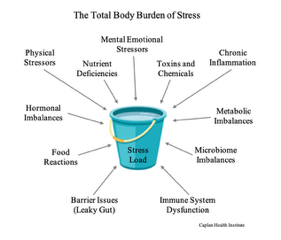
Another action you can take to counteract stress is to divide out your stressors into two parts: 1) things you can modify, change, control, or avoid and 2) those stressors that you can do nothing about. Imagine dumping all those factors into a bucket. That way you’ll know which stressors you can take action on and which stressors you can’t do anything about. Even if you can’t completely avoid a particular stressor at least you can be more conscious about how you can react in that situation. The goal is to deal with all of your stressors without having that stress bucket overflow.
Falling Off the Wagon with Your Stress-Management Techniques
Another harmful habit is not consistently practicing stress-relief techniques. You need to have routines that are breaking the cycle of your body’s fight-or-flight reaction so that your body can get into a rest-and-digest state on a regular basis. Not having a consistent stress-relief routine is harmful because your body continues to be in that fight-or-flight state until you make it stop.
Fight-or-flight is an innate survival reaction. Back in ancient times, people entered that mode when, for example, they encountered a saber-toothed tiger and had to either fight or run for their lives. The threat from the tiger was temporary, so when the danger disappeared the body went back into its rest-and-digest state.
Today, people enter that same fight-or-flight state when they’re under any kind of stress, including stress from financial problems, deadlines, work, and family issues. Since those problems are ongoing, our body stays in the fight-or-flight state. We have to purposely take action to shut down fight or flight. When this stress state is shut off, we can heal and repair. The nervous system and immune system shift into a stable state and are capable of healing the body. When you don’t develop habits that are outlets for your stress, you get stuck in fight or flight.
Shying Away from Professional Support
A lot of times it does take an outside perspective to help identify and resolve stress. By talking to people or reading their history, I can easily point out the things that aren’t working well in their body and these are the areas that need to be addressed. Working with a functional medicine provider who has access to objective data and labs can provide information you would never have on your own.
Breaking Daily Bad Habits
Sometimes, we need outside help to identify the harmful habits that may be impacting our autoimmune disease. At the Caplan Health Institute, we can employ strategies to help you break those bad habits and reach your health goals.
The first step? Schedule a free 15-minute discovery consultation, by phone or video.
If you decide to come on board as a practice member, we can order tests and create a personalized plan to show you which strategies will work best for you. We call our patients “practice members” because they take an active role in their health. In addition, our Caplan Health Institute coaches can work with you to make sure you’re staying on track and not slipping backward. By lowering stress and building better habits around food and exercise, you can stop the autoimmune process in its tracks.
Leave a Reply