
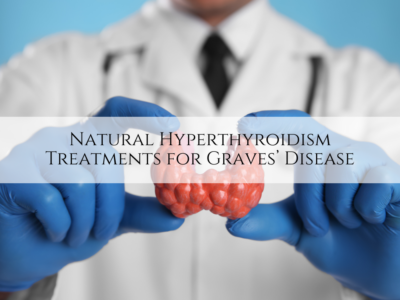
Graves’ Disease Natural Solutions — A Functional Medicine Approach
Like other autoimmune diseases, Graves’ disease presents a whole set of challenges for anyone using a functional medicine approach. The key, as with other autoimmune diseases, is to find the root cause of the root cause of the problem. This isn’t always easy, but with some detective work, we can use the best natural remedies for Graves’ disease symptoms.
In this blog post, I’ll address the natural remedies for Graves’ disease we use at the Caplan Health Institute. The goal is to relieve Graves’ symptoms. But first, let’s learn more about what Graves’ disease actually is and how to avoid confusing it with another common thyroid condition.
What Is Graves’ Disease?
Graves’ disease is an autoimmune disorder and a common cause of hyperthyroidism, the overproduction of thyroid hormones. In this condition, the immune system makes an antibody to cells in the thyroid gland, causing the immune system to think of the gland as foreign to the body and launching an attack against it.
A hormone secreted by the pituitary gland, a small gland at the base of the brain, normally regulates thyroid function. The Graves’ disease antibody, known as thyrotropin receptor antibody (TRAb), mimics the regulatory actions of the pituitary hormone, hijacking normal control of the thyroid. This in turn causes the thyroid to churn out an excess of thyroid hormones, leading to the hyperthyroidism of Graves’ disease.
Your doctor will suspect you have Graves’ disease if your blood test shows high levels of the thyroid hormones T3 and T4 and low levels of thyroid-stimulating hormone (TSH). If everything is working normally, the brain senses that your levels of T3 and T4 are low. Using TSH, the pituitary gland then signals the thyroid gland to make more T3 and T4. In the liver and throughout the body, T4 is converted to T3.
During hyperthyroidism, your thyroid hormones are overstimulated and your thyroid makes too much of them. When your T4 or T3 levels are too high, it tells the pituitary gland to put the brakes on making TSH—hence the low TSH levels that occur during Graves’ disease.
Is it Really Graves’ Disease?
However, there’s a catch. One of those first questions I ask when somebody comes to me with hyperthyroidism or Graves’ is if they’ve had the antibody test for Grave’s specifically. This is because there is another thyroid disorder called Hashimoto’s thyroiditis that can be confused for Graves’.
Hashimoto’s can act as both hyperthyroidism and hypothyroidism (low thyroid function). Most of the time, a Hashimoto’s patient will be hypothyroid, but it can flare up and create hyperthyroid symptoms that can be mistaken for Graves’.
We don’t want to just jump to the conclusion that the problem is Graves’, especially because Graves’ is not nearly as common as Hashimoto’s. Some doctors might diagnose you with hyperthyroidism and not really distinguish between whether it’s Graves’ or Hashimoto’s, but it can make a difference.
In order to determine that it’s Graves’ disease, I look for positive thyroid stimulating immunoglobins (TSI) on a patient’s blood test. TSI is an antibody that mimics the actions of thyroid-stimulating hormone (TSH), which causes the thyroid to make more of the thyroid hormones, T3 and T4.
The TSI test tells me if your immune system is overstimulating your thyroid function and causing your gland to overproduce hormones. The result? You’ve entered a hyperthyroid state. If the TSI level is normal, then your hyperthyroidism may be a flare-up of Hashimoto’s rather than Graves’.
Graves’ Disease Symptoms
People who have Graves’ disease often have one or more of the following symptoms:
• Bulging, gritty, irritated eyes (Graves’ ophthalmopathy)
• Enlarged thyroid (goiter)
• Fast or irregular heartbeat
• Fatigue
• Frequent bowel movements
• Heat intolerance
• Irritability
• Nervousness
• Shaky hands
• Sweating
• Trouble sleeping
• Weak muscles
• Weight loss, even when you have increased hunger
Diagnosing Graves’ Disease
It’s always important with any question or concern about thyroid health to get the full panel of thyroid hormones checked and not just TSH, which is typically the only thing measured in conventional lab tests. It’s important to actually see someone’s level of T4 and T3 and the free hormones to know what part of the thyroid hormone pathway is being affected.
There is another measurement called reverse T3. Sometimes I like to measure reverse T3 on the thyroid blood panel as well, because reverse T3 can block the conversion of excess T4 into T3. We can usually figure out what a person’s reverse T3 is doing by looking at T4 and T3. If you have a lot of T4 and little T3, we know that something is blocking T4 from converting to T3 and that something is likely high reverse T3.
Besides the thyroid hormone pathway directly, there might be some other factors that are causing problems. Hormones are powerful molecules and the body keeps them tightly controlled for optimum health. Hormones can be bound up or free. When a hormone is bound, it is not biologically active. It cannot act on cells and tissues. It acts as a storage form of the hormone, kept in reserve. When hormones are free, they can act throughout the body. Health problems arise when there are imbalances, such as too many bound hormones (poor hormone signaling) or too many free hormones (excess hormones).
For example, thyroid hormones control the production of a hormone known as sex hormone binding globulin (SHBG). Thyroid hormone levels are linked to SHBG levels. If someone has problems with their SHBG production and their liver isn’t producing SHBG properly, then they’re going to have a lot more free hormones being active than total hormone. That’s going to cause problems because it’s the active form of thyroid hormones that are causing more symptoms.
If it was the other way around and you have more SHBG then that would cause you to hold on to the thyroid hormone and keep it from becoming free. Then you could have a lot of hormones floating around, but they’re not as active as free hormones and aren’t getting into the tissues and causing problems.
Graves’ Disease Treatment Options
There are three conventional medicine treatment approaches to Graves’ disease:
1) Try to shut down the thyroid gland using medication,
2) surgically remove the thyroid gland, or
3) irradiate the thyroid.
However, Graves’ disease treatment side effects can be a problem. For example, anti-thyroid medications can cause joint pain, liver failure, or decreased counts of white blood cells that help fight diseases.
On the other hand, functional medicine takes a more conservative approach, depending on the severity of the Graves’ disease. If you’re in an active flare up that you can’t get out of, you might need medication initially to calm it down. In severe cases, Graves’ can be fatal, so it’s best to work with a functional medicine doctor and not try to stop taking medications on your own. There are natural ways to get the immune system into a more balanced state where it will calm down and slow down thyroid hormone production.
Natural Hyperthyroidism Treatments
As with all autoimmune diseases, we need to ask what’s the root cause of the root cause of your Graves’? We need to look at other systems of the body besides the thyroid gland. Hormonal imbalances and adrenal, cortisol, or blood sugar problems, can all cause an imbalanced immune system and affect the thyroid gland.
Likewise, if you have leaky gut and you are reacting to foods you’re eating, it can affect thyroid function. The gut houses about 80% of the immune system. A lot of times it’s the same common foods that trigger intolerances, such as grains, dairy, and sugar. Foods that are more inflammatory will create an imbalanced immune response because they’re interacting with the gut immune system.
To calm down the thyroid, we also need to find out what’s going on with the gut microbiome because microbiome imbalances can impact the immune response. In addition, if there are any chronic infections anywhere in the body, such as Epstein Barr virus, chronic sinusitis or sinus infections, or chronic urinary tract infections (UTIs) all those things are going to create an overactive imbalanced immune response.
Another natural Graves’ disease treatment approach is to look for factors you can control or modify in your lifestyle. Stress management can be really helpful. Helping our body handle stress, making our body more resilient to tense situations, and modifying the types of stress that we have control over, helps our immune system function properly. Incorporating regular self-care routines into your schedule acts as a natural stress reliever and helps to calm down an angry immune system.
Making sure you’re getting adequate sleep and going to bed at the same time every night also helps cope with stress and boosts immunity, which in turn can support thyroid health.
Even something as simple as drinking enough water every day can help make sure your body is detoxing well. The Mayo Clinic suggests aiming for 15.5 cups of fluids per day for men and 11.5 cups for women.
Graves’ Disease Supplements
Nutrient deficiencies can play a role in Graves’ disease. The top nutrients to think about are vitamin D, magnesium, glutathione, omega-3s, and antioxidants. Some people with Graves’ can be really low in these nutrients or need even more of them if they’re in an acute flare.
Antioxidants are particularly beneficial because when the thyroid is overproducing and overworking you’re going to have more oxidants formed, you’re going to have more oxidative stress. The antioxidants can help quench the oxidants.
Too many oxidants cause oxidative stress, when free radicals overload the system and cause many diseases. Free radicals are damaging oxygen molecules that are made through daily wear and tear in cells, but also come from inflammation and infection.
The one supplement to use with caution is iodine, which makes the thyroid work more efficiently and make more thyroid hormones. This might be the last nutrient to use with somebody who already has overactive production of thyroid hormone. I normally recommend avoiding iodine with my Graves’ patients at least until we can get at the root cause of the problem and settle things down.
Although it is an essential element for health, iodine is not necessarily a good thing for people with Graves’ or Hashimoto’s thyroid disorders. With conditions like Hashimoto’s, a person might even feel better initially taking iodine, but the reason why he or she is feeling better is because it helps produce extra hormones. The iodine can make someone feel better, but it is actually wearing out the thyroid gland, causing more immune destruction to the thyroid gland. Because of the delicate balance needed to protect the thyroid gland, it is best to work with an experienced integrative and functional medicine practitioner for your nutritional regimen, especially iodine.
Graves’ Disease Natural Solutions at our Clinic
Graves’ disease can be difficult to address but there are natural solutions. At the Caplan Health Institute, we can work with you to customize an approach that gets at your specific root causes. We can also make sure you have the right testing panel to make certain you have Graves’ and not Hashimoto’s.
The first step? Schedule a free 15-minute discovery consultation, by phone or video. If you decide to come on board as a practice member, the goal is to calm down your thyroid by addressing the factors that caused you to develop this condition in the first place. By stopping your thyroid from going into overdrive and reducing your Graves’ symptoms, we can help you feel calmer, get more restful sleep, and stay more energized, along with supporting eye health and keeping you at a healthy weight.
Leave a Reply